Three Months of Iran-Linked Attacks on the Kurdistan Region of Iraq: 751 Attacks, 22 Killed, 112 Injured
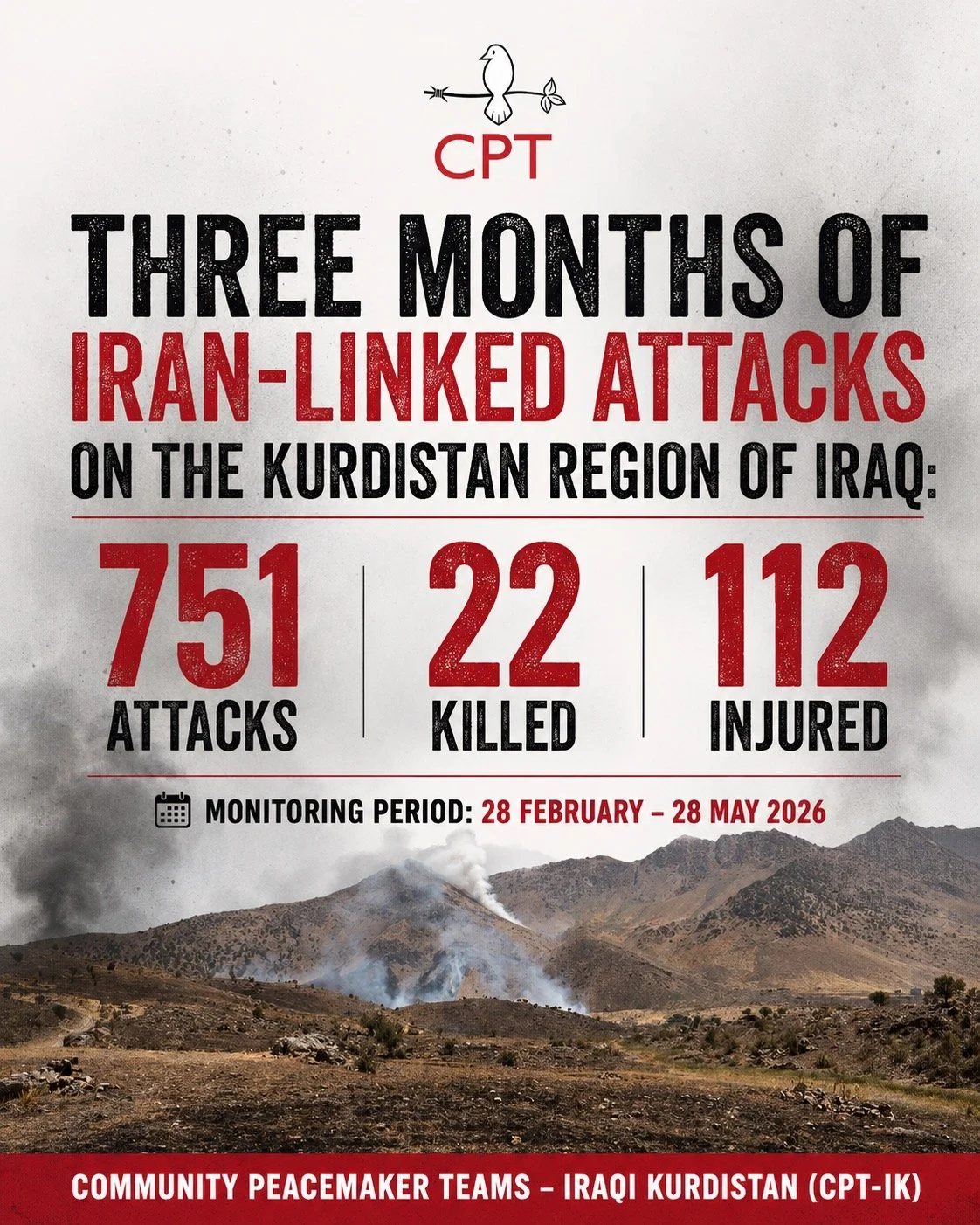
Monitoring Period: 28 February – 28 May 2026
Since the outbreak of the war involving the United States, Israel, and the Islamic Republic of Iran on 28 February 2026, the Kurdistan Region of Iraq (KRI) has experienced a sustained wave of attacks carried out by Iranian forces and Iran-backed Iraqi militia groups.
Community Peacemaker Teams – Iraqi Kurdistan (CPT-IK) documented 751 attacks across the Kurdistan Region between 28 February and 28 May 2026. These attacks included suicide drone strikes, rockets and missiles, artillery shelling, and gunfire incidents.
The vast majority of attacks, 647 incidents, occurred during the first 40 days of the conflict, before the ceasefire was announced on 8 April 2026. During this period, U.S. diplomatic and military facilities were the primary targets, accounting for 277 attacks (42.8%).
Despite the ceasefire, attacks did not stop. Between 8 April and 28 May 2026, CPT-IK documented an additional 104 attacks, primarily targeting Iranian Kurdish opposition groups and their camps within the Kurdistan Region.
This report presents an overview of attacks recorded by CPT-IK during the three-month monitoring period as well as an analysis of attack patterns during the ceasefire period.
Overall Attacks Count: 28 February – 28 May 2026
Total Recorded Attacks
751 attacks
Responsible Actors
Iranian forces: 298 attacks (39.7%)
Iran-backed Iraqi militia groups: 453 attacks (60.3%)
Type of Attacks
Suicide drones: 589 attacks (78.4%)
Rockets and missiles: 149 attacks (19.8%)
Artillery shelling: 12 attacks (1.6%)
Gunfire: 1 attack (0.1%)
Casualties
Killed: 22 people
10 individuals affiliated with Iranian Kurdish opposition groups
12 civilians, members of Iraqi Kurdish security forces, and other non-belligerents
Injured: 112 people
46 individuals affiliated with Iranian Kurdish opposition groups
66 civilians, members of Iraqi Kurdish security forces, and other non-belligerents
Iranian Kurdish opposition groups include both armed members training for armed resistance against the Iranian government and civilians engaged in political and civil advocacy for Kurdish and democratic rights in Iran. The locations targeted by Iran and its allied groups included not only training camps, but also residential areas inhabited by civilians, including children and family members.
Geographic Distribution of Attacks
Erbil Governorate: 588 attacks (78.3%)
Sulaymaniyah Governorate: 135 attacks (18.0%)
Duhok Governorate: 22 attacks (2.9%)
Halabja Governorate: 6 attacks (0.8%)
Targeted Locations
U.S. diplomatic and military facilities, including the U.S. Consulate in Erbil and U.S. military and intelligence bases: 281 attacks (37.4%)
Civilian and non-belligerent infrastructure, including Kurdistan Region security facilities, residential areas, oil fields, refineries, telecommunications companies, and other civilian locations: 238 attacks (31.7%)
Iranian Kurdish opposition groups and camps: 232 attacks (30.9%)
Key Observations
Iran-backed Iraqi militia groups were responsible for the majority (60%) of attacks during the reporting period.
Suicide drones emerged as the primary method of attack, accounting for more than three-quarters of all incidents documented by CPT-IK.
Erbil Governorate remained the primary target area throughout the conflict, receiving more than three-quarters of all attacks.
Civilian and non-belligerent infrastructure faced extensive exposure to attacks, highlighting the broader impact of the conflict on the civilian population and public infrastructure within the Kurdistan Region.
Attack Patterns During the Ceasefire Period: 8 April – 28 May 2026
Although the ceasefire announced on 8 April 2026 led to a significant reduction in the overall number of attacks, targeted strikes continued across the Kurdistan Region of Iraq and became predominantly concentrated on Iranian Kurdish opposition groups.
Total Recorded Attacks
104 attacks
Responsible Actors
Iranian forces: 92 attacks (88.5%)
Iran-backed Iraqi militia groups: 12 attacks (11.5%)
Type of Attacks
Suicide drones: 75 attacks (72.1%)
Rockets and missiles: 27 attacks (26.0%)
Artillery shelling: 2 attacks (1.9%)
Casualties
Killed: 5 people
Injured: 17 people
All casualties recorded during the ceasefire period were members of Iranian Kurdish opposition groups.
Geographic Distribution of Attacks
Erbil Governorate: 78 attacks (75.0%)
Sulaymaniyah Governorate: 24 attacks (23.1%)
Duhok Governorate: 2 attacks (1.9%)
Halabja Governorate: 0 attacks (0%)
Targeted Locations
Iranian Kurdish opposition groups and camps: 86 attacks (82.7%)
Civilian and non-belligerent locations: 14 attacks (13.5%)
U.S. diplomatic and military facilities: 4 attacks (3.8%)
Key Observations
Despite the ceasefire, Iran and Iran-backed Iraqi militia groups continued to carry out attacks in the Kurdistan Region of Iraq.
During the ceasefire period, attacks shifted overwhelmingly toward Iranian Kurdish opposition groups.
Iranian forces became the principal actor responsible for attacks during this period, carrying out nearly 89% of documented incidents.
Suicide drones remained the dominant weapon used in attacks, being used in nearly three-quarters of all incidents.
Erbil Governorate continued to experience the highest concentration (75%) of attacks.
Recommendations
The continued attacks by Iranian forces and affiliated Iraqi militia groups demonstrate the ongoing instability and security risks facing the Kurdistan Region of Iraq.
Community Peacemaker Teams – Iraqi Kurdistan calls on all parties involved in the war to reach and implement a binding agreement that ensures a full cessation of hostilities and prevents further attacks within the Kurdistan Region’s territory.
The Government of Iraq should take concrete measures to uphold the sovereignty of its territory and hold accountable the Government of the Islamic Republic of Iran as well as the armed groups operating from within Iraqi territory.
The Kurdistan Regional Government and the Government of Iraq should also ensure timely compensation and assistance for civilians affected by the conflict, in accordance with Iraqi Law No. 20 of 2009 and amended Law No. 57 of 2015 approved by the Iraqi Council of Representatives.