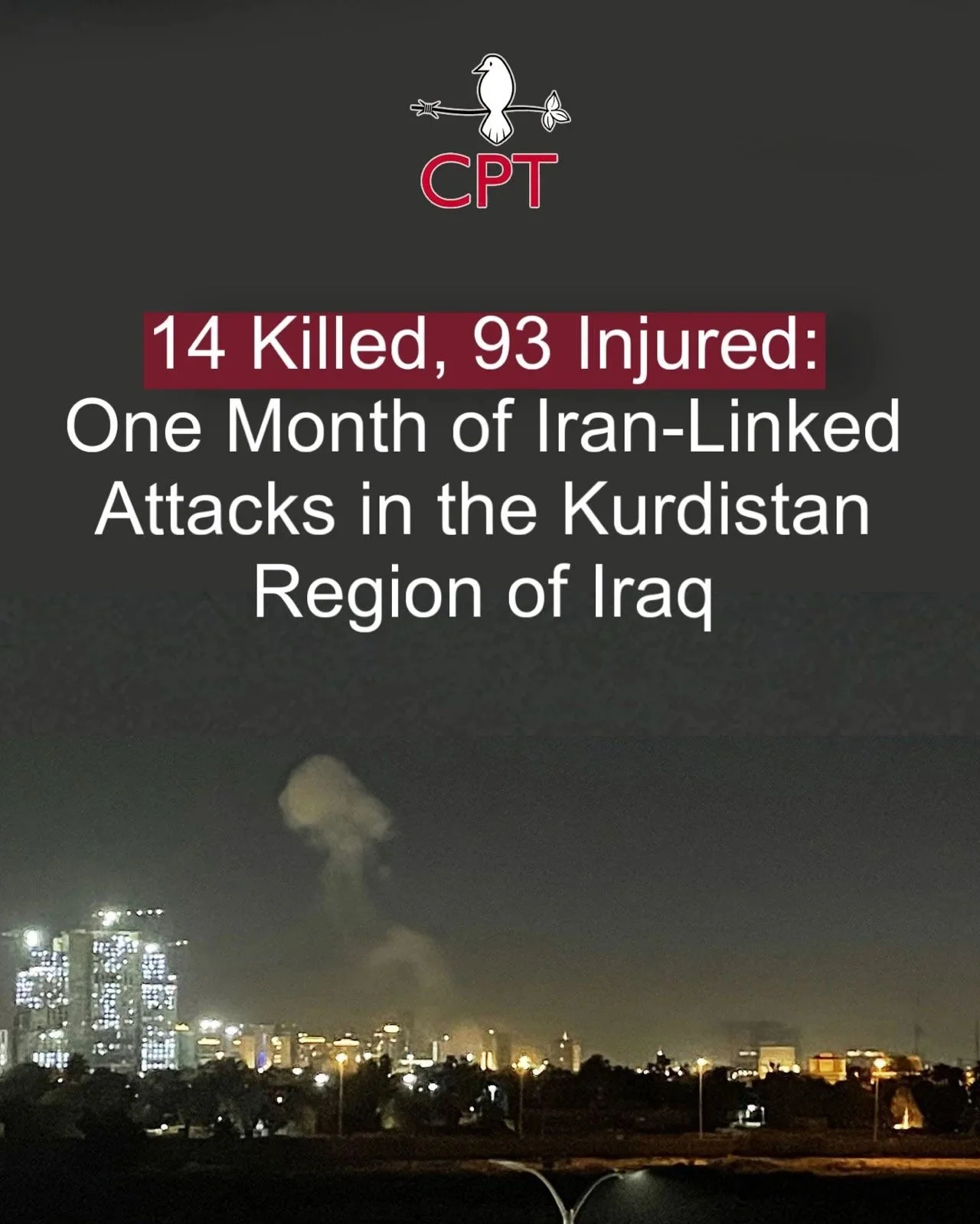
14 Killed, 93 Injured: One Month of Iran-Linked Attacks in the Kurdistan Region of Iraq
CPT-IK REPORT: 30 March 2026
Since the beginning of joint attacks by the United States and Israel against Iran, the Iranian Revolutionary Guard Corps (IRGC) and its affiliated groups in Iraq have conducted at least 474 attacks targeting the U.S. Consulate, U.S. military bases, camps and headquarters of Iranian Kurdish opposition parties in the Kurdistan Region, bases of the Kurdistan Regional Government’s Ministry of Peshmerga, oil fields, telecommunications towers, residential buildings, public spaces, and several non-governmental institutions.
Community Peacemaker Teams – Iraqi Kurdistan (CPT-IK) has documented and verified these attacks, as well as their impact on civilians.
Attack Count
As of 27 March 2026, 474 attacks had been carried out within the Kurdistan Region. Of these, the IRGC conducted 179 attacks, while affiliated groups in Iraq carried out 295.
The majority of attacks, 370 in total, targeted the Erbil Governorate (which accounts for 78.06% of the attacks). Sulaymaniyah Governorate recorded 90 attacks (18.99%), followed by Duhok Governorate with 11 attacks (2.32%), and Halabja Governorate with 3 attacks (0.63%).
Although the IRGC and its affiliated groups claim to target U.S. bases, intelligence facilities, and armed groups, CPT-IK has observed that, alongside U.S. consular and military sites and Iranian Kurdish opposition parties, civilian residential areas and civilian and official institutions of the Kurdistan Regional Government have also been targeted, despite having no connection to the war of the United States and Israel against Iran.
U.S. consular and military sites were targeted 181 times (38.19% of attacks), while Iranian Kurdish opposition parties were targeted 121 times (25.53%). Civilian areas, civilian institutions, and Peshmerga bases—none of which are parties to the conflict—were targeted 172 times (36.29%).
Based on CPT-IK observations, most attacks in Erbil and Duhok governorates were carried out by Iran-affiliated militia groups in Iraq, while most attacks in Sulaymaniyah were conducted directly by the IRGC.
Of the 474 attacks, 359 involved suicide drones (75.74%), 104 involved missiles (21.94%), 10 involved artillery shelling (2.11%), and one involved gunfire (0.21%). Of these, 228 were intercepted or neutralized by air defense systems or fell before reaching their intended targets, meaning that 60.76% of drones and missile attacks failed before impact.
Casualty Count
As a result of the 474 attacks recorded up to 27 March 2026, 14 people were killed and 90 injured, for a total of 104 casualties.
On 28 March, Iran-linked actors launched approximately 37 additional attacks, injuring 3 more people. CPT-IK has not yet been able to verify the full breakdown of these attacks, beyond confirming the number of casualties.
From 28 February to 29 March 2026, Iran-linked attacks resulted in 107 total casualties: 14 killed and 93 injured. Of these, 19 were civilians, all of whom were injured.
In addition to human casualties, the attacks damaged at least 46 civilian homes and 32 civilian vehicles. The threat posed by these attacks has also led to the suspension of education in schools, institutes, and universities.
Recommendations
Community Peacemaker Teams – Iraqi Kurdistan (CPT-IK) views these developments with deep concern. The targeting of civilian residential areas, the residence of the President of the Kurdistan Region, official and civilian institutions of the Kurdistan Regional Government, and private companies indicates a potential expansion of the conflict and its growing impact on civilian life.
While condemning the actions of all parties involved, CPT-IK calls for an immediate end to the attacks both on Iran and on the Kurdistan Region. Civilian lives must be protected, and those affected must be compensated without delay.
The Iraqi government must also take responsibility by pursuing diplomatic efforts to protect the Kurdistan Region and Iraq, and by holding accountable all groups and actors operating within Iraq that carry out such attacks.